.png)
Why the Rules of Cavities Change During Menopause (And What to Do About It)

You’ve brushed and flossed the exact same way for decades. You don't eat a ton of candy. Yet suddenly, you’re sitting in the dental chair and hearing that you need three new fillings. To make matters worse, your mouth constantly feels parched, and your gums are more sensitive than ever.
You might be wondering, “What am I doing wrong?”
The answer is: absolutely nothing. You are simply experiencing the realities of the effects of menopause on your mouth (aka Menopause Mouth). Just like the rest of your body, your mouth and your saliva have changed right along with the many other shifts of aging and menopause. Understanding this is the key to knowing what has changed and what you need to do differently—because, quite simply, you are a different version of yourself now.
For years, we’ve been handed a very simplified story: sugar causes cavities. End of story. But that narrative completely ignores the complex, beautiful, and dynamic chemistry of your body. As our hormones shift during perimenopause and menopause—specifically the drop in estrogen—our oral environment structurally changes. Our saliva changes and often our oral microbiome changes.
Decay isn't just a food issue; it’s a chemistry issue. Let's break down the verified, scientific root causes of tooth decay, how the rules change during menopause, and how you can take back control of your oral and systemic health.
Until menopause - this is true for everyone :
If you have decay causing bacteria in your mouth - you have an acid problem.
If you have plaque in your mouth - you have bacteria - and then you have an acid problem.
If you have acidic saliva in your body - then you are at higher risk of decay - and then you have an acid problem
If you snack or sip all day - you have an acid problem
After Menopause:
Your saliva becomes more sparse, and less capable of remineralizing your teeth and your saliva becomes more acidic with time - now you have a bigger acid problem.
If you sip acidic drinks - to address the dry mouth - now you have a bigger acid problem.
Part 1: Foundations of Oral Decay—The New Danger Zone
Menopause makes keeping your teeth remineralized harder! But not impossible.
Understanding how cavities actually form is the first step to stopping them in their tracks. As we navigate the effects of menopause on our mouth, our natural defenses—especially our protective saliva—change. Because you are a different version of yourself now, this cycle of decay can happen much faster and with less provocation than it used to.
Here is exactly what is driving that cycle:
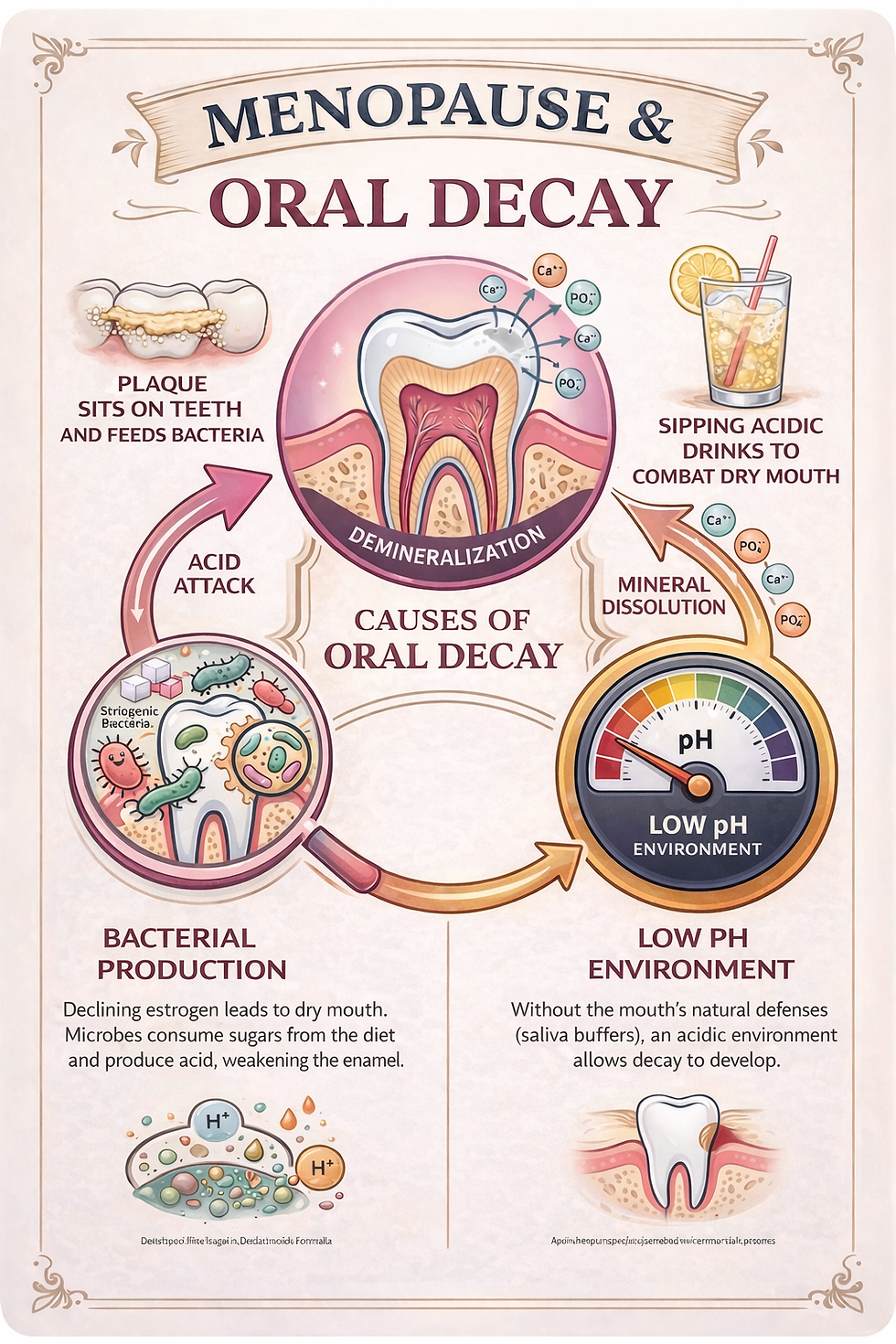
Here is how these foundational elements work against you now:
The Instigators (Bacteria & Carbohydrates): Decay doesn't happen spontaneously. Plaque isn't just leftover food; it is a sticky, living microscopic city where cavity-causing bacteria thrive. Whenever you consume fermentable carbohydrates, these bacteria immediately eat them and pump out harsh organic acids directly against your tooth.
The Danger Zone (Low pH Exposure): The acids produced by the bacteria rapidly drop the overall pH of your mouth into a highly acidic state. Normally, an abundant flow of saliva washes this acid away. However, with the dry mouth that often accompanies estrogen drops, your teeth are left soaking in this acidic environment with no protection.
The Damage (Demineralization): When your mouth's pH drops below a critical threshold, the acid literally dissolves the structural minerals right out of your teeth. Vital minerals like calcium and phosphate are pulled away, leaving the tooth porous and weak. If the acid attacks happen too frequently, the tooth structure eventually collapses, creating a cavity.
Part 2: The pH Landscape and Why Your Rules Changed
To manage your decay risk, you have to manage your pH landscape. Healthy saliva is slightly basic, packed with minerals and buffers to neutralize acids. But when we eat or drink, things get acidic.
For women in menopause, there are two key thresholds you must memorize:
Enamel Critical pH (5.5): The outermost armor. Below 5.5, the armor dissolves.
Dentin/Root Critical pH (6.2 to 6.7): This is the game-changer. As we age, gums recede, exposing roots made of dentin. Dentin needs much less acid (a higher pH) to start dissolving.
Drink | Approximate pH | What it means for your newly vulnerable teeth |
Diet Soda / Cola | 2.5 – 2.7 | Highly Acidic. Dissolves enamel and roots instantly. |
Lemon Water | 2.0 – 2.4 | Extremely Acidic. Highly erosive. |
Black Coffee | 4.5 – 5.0 | Acidic. Enough to trigger root decay. |
Plain Water | 7.0 (Variable) | Neutral. The goal! |
Part 3: Why Snacking is Worse Than Dessert (The Stephan Curve)
When you consume carbohydrates, your mouth's pH plummets instantly. If you eat a cookie, your mouth might take 30 to 60 minutes to neutralize again. But if you slowly sip a sweetened latte every 20 minutes for three hours, your mouth never gets to recover. Your teeth remain below that critical 5.5 pH (or 6.2 on the roots) for hours.
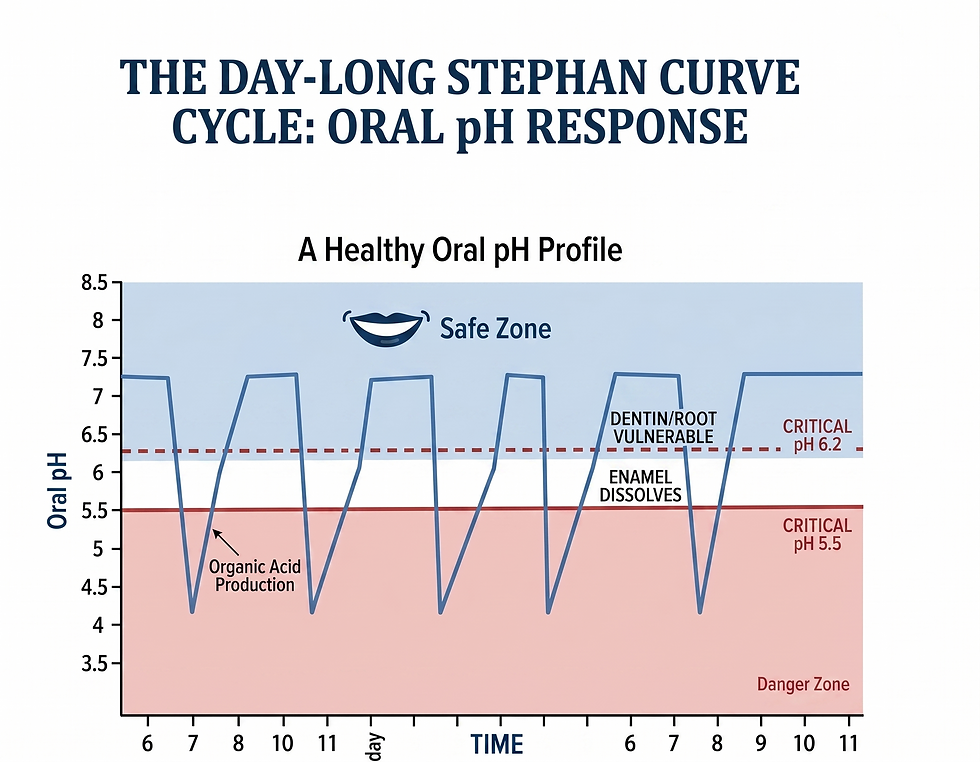
It is better to eat sweets once and let your saliva recover than to constantly graze or sip all day.
Part 4: The Dry Mouth and Mouth-Breathing Risk
Your mouth loses protection when saliva flow drops.
Estrogen Drops: Estrogen regulates salivary glands. When estrogen falls, dry mouth (xerostomia) increases. Your liquid armor (saliva) is missing.
Mouth Breathing: If you sleep with your mouth open, the constant airflow evaporates any remaining saliva. This keeps your mouth in the high-acid danger zone overnight, accelerating decay dramatically. Focus on nose breathing (functional breathwork used in yoga is great for this) to keep your oral tissues hydrated.
Part 5: Foundations of Remineralizing Teeth—The Repair Team
The good news? The decay process can be reversed before a physical cavity forms. When your mouth’s pH rises back to a safe level, minerals from your saliva precipitate back into the porous enamel matrix. This healing process is called remineralization.
However, to heal, your body requires specific nutritional partners working in precise synergy:
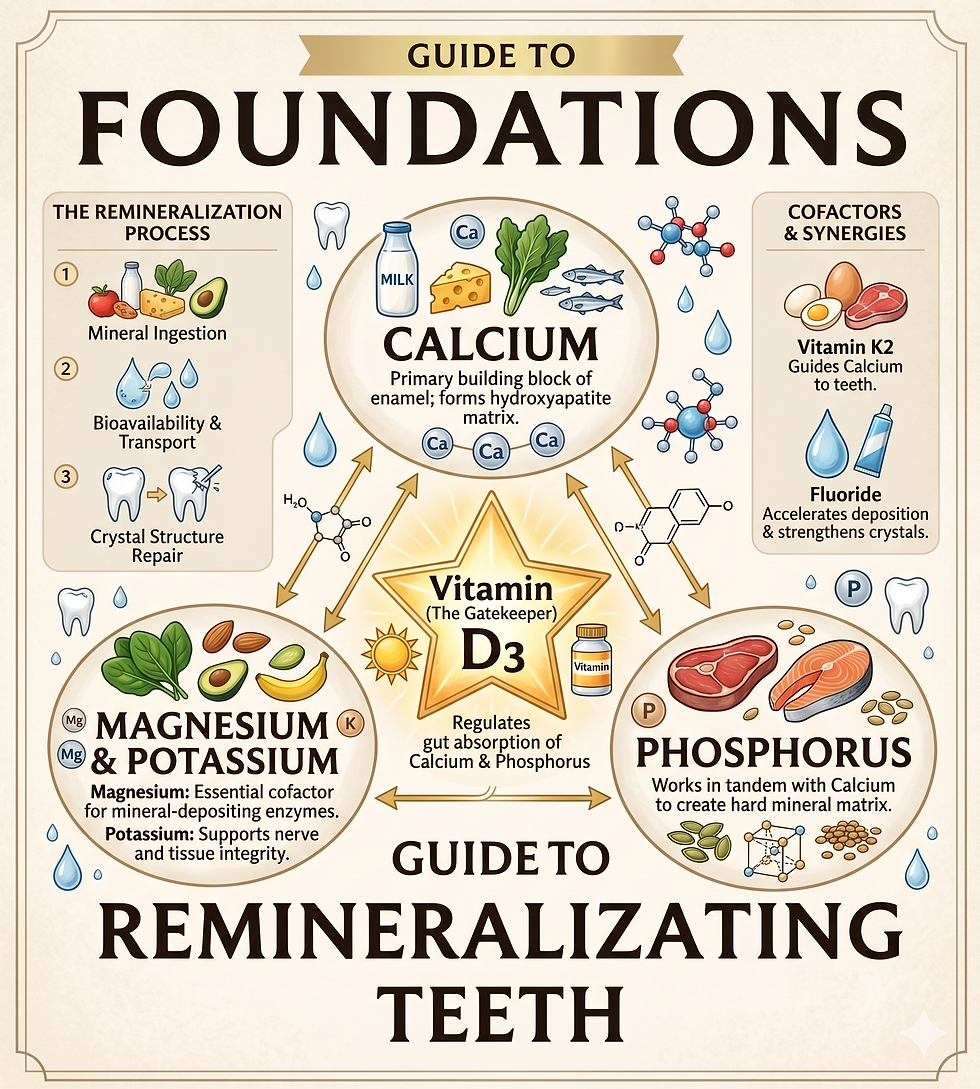
Here is your natural repair team and how you need to equip them:
The Foundation Builders (The Minerals)
These are the physical raw materials that rebuild the mineral crystals on your tooth.
Calcium: Think of this as the main "brick." It builds the primary hard matrix of your enamel.
Phosphorus: Calcium's essential partner. They bind together to form the incredibly hard surface of your teeth. Low phosphorus can restrict remineralization even if calcium is high.
Magnesium & Potassium: The "co-factors." They help your body activate the enzymes needed to place the minerals and support overall tissue health. Magnesium makes sure calcium actually goes into your teeth and bones rather than building up in your arteries.
The Support Team (The Helpers)
Minerals are great, but they cannot perform systemic transport and cell-level deposition alone.
Vitamin D3 (The Gatekeeper): This is non-negotiable! Vitamin D regulates your gut, allowing you to absorb the Calcium and Phosphorus you eat into your mineral pool. If you are low in Vitamin D, your body cannot use the builders effectively.
Part 6: The Danger Beyond the Enamel
The reason we obsess over the root causes of decay is not just to save your smile. The mouth is the entry point to your body, and untended decay puts massive strain on your overall systems.
Bacteremia (Entry into the Bloodstream): When you have advanced decay or bleeding gums, you have open wounds in your mouth. Everyday actions like chewing can push oral pathogens directly into your bloodstream. Once circulating, these bacteria trigger systemic inflammation, straining your cardiovascular system.
Aspiration Risk: If your mouth is full of cavity-causing bacteria, every time you swallow saliva, those bacteria travel down. In vulnerable populations, microscopic amounts of this bacteria-laden saliva can be inhaled into the lungs (aspiration), putting extra strain on the pulmonary system.
Conclusion
The effects of menopause on your mouth are real, but they are not your destiny. By understanding the functional chemistry of your mouth—protecting your saliva, breathing through your nose, giving your teeth breaks between meals, and loading up on mineral-rich whole foods—you can profoundly change your oral environment.
Root cause dentistry means recognizing that your mouth is the frontline of your systemic health. Fighting decay isn't just about avoiding sugar. It’s about managing your systemic chemistry, so your body can rebuild the strongest substances it makes, defending the gateway to your overall well-being. Embrace this different version of yourself, equip your body with what it needs, and take back control of your oral health.


Comments